
MyGooru delivers measurable outcomes across K-12 schools, colleges, corporate training, skills programs, and EdTech platforms—demonstrating how AI-powered personalization drives engagement, accelerates competency development, and improves productivity at scale.

MyGooru delivers measurable outcomes across K-12 schools, colleges, corporate training, skills programs, and EdTech platforms. Validated implementations include:
Leadership Public Schools (LPS): 2.82x math learning growth for 9th graders entering with gaps at 2nd grade level and above
Lammersville USD: At least 20% increased teacher productivity; ELL students mastered 35 algebraic competencies per semester
Internshala: Course completion rose from 45% to 75%; 60% job placement within three months; 30% dropout reduction
NEETPrep: 15 percentile point improvement in mock test scores; 40% better retention of challenging concepts
Tennessee Mental Health: 85% certification completion for peer mental health workers
Gyan Prakash Foundation (India): 89% of teachers reported improved student competency development across 75,000+ students
EdTech integration: MyGooru APIs and Widgets deploy within 2 weeks, enabling 75 minutes of engagement per week and 13 competencies gained per month
Institutions
From bustling classrooms to the most remote villages, MyGooru delivers measurable improvements in learning outcomes. We are proud to partner with:
K-12 Schools in California: Empowering teachers and students in modern districts with AI-driven personalization.
Rural Education Programs in India: Bridging learning gaps in remote regions with limited infrastructure.
Large-Scale Institutional Deployments: Powering national and regional education initiatives in the Middle East and South Africa.
NGOs in Zambia: Providing critical access to education for out-of-school children with limited to no connectivity.
Across every context, MyGooru demonstrates a truly scalable and equitable solution for learners everywhere.
At Lammersville Unified School District, Middle School English Language Learners use MyGooru to master Math concepts at their own pace. The app automatically adjusts the language complexity of math problems and explanations to match each student's English proficiency, while maintaining grade-level mathematical rigor. Students typically spend 20-30 minutes per session, 3-4 times per week. Data shows ELL students have mastered an average of 35 algebraic competencies over a semester, bringing their mathematical understanding in line with grade-level expectations. Meanwhile, advanced students in the same classes use MyGooru to explore topics beyond the standard curriculum, with 15% progressing into Algebra 2 concepts. Teachers report 20% higher classroom engagement as students come better prepared, allowing more time for collaborative problem-solving.




In India, Saveetha School's digital learning platform The Pupil has integrated MyGooru to transform after-school science learning across India. Grade 8-10 students use the app to strengthen their understanding of physics and chemistry concepts through personalized practice. The app identifies knowledge gaps and automatically adjusts the complexity of explanations and problems based on each student's demonstrated understanding. Students average 40 minutes per session in the evenings, with 70% showing improved classroom test scores after regular app usage. The most engaged students master over 50 science competencies per semester, with teachers noting these students ask more sophisticated questions during class discussions. Parents report that the app's ability to provide immediate feedback and adjust difficulty levels has made independent study time more productive.

Across these implementations, MyGooru App demonstrates its ability to serve as an effective supplemental learning tool that adapts to diverse student needs. Key success factors include:
Personalized learning paths that respect both subject matter requirements and individual student contexts
Automatic adjustment of content complexity based on student responses
Real-time progress tracking that helps students stay motivated
Language and cultural adaptations that make learning accessible
Flexible scheduling that enables students to learn at their own pace
The result is a learning companion that truly personalizes education at scale, helping students build strong academic foundations through independent study while making classroom time more productive for teachers.
iQuasar has adopted MyGooru to streamline onboarding and enhance employee training across multiple departments. From new hires to experienced professionals, team members now access personalized learning paths covering communication skills, quality assurance, and more. By leveraging MyGooru’s adaptive training capabilities, iQuasar ensures consistent, scalable skill development while tracking progress in real time — creating a more prepared, confident workforce.
Examples of some of the courses currently being used with MyGooru:
Software Quality Assurance
Google Looker Studio
Intermediate Digital Literacy
Basic Cybersecurity Hygiene
Government Proposal Development Process


The Tennessee State Department of Education demonstrates MyGooru App impact in specialized professional development. The state uses the platform to train recovered mental health workers to support K-12 students, creating a unique peer support network. MyGooru adapts training content based on each participant's lived experience and learning style, while providing mentors with real-time insights into trainee progress. Participants spend an average of 5 hours weekly on structured learning modules, with the system automatically adjusting content depth based on demonstrated understanding. After six months, 85% of trainees successfully complete the certification program, with supervisors reporting that the platform's ability to blend theoretical knowledge with practical application has significantly improved the quality of support provided to students.
Gyan Prakash Foundation (GPF) showcases MyGooru Apps effectiveness in transforming public education across Maharashtra and Goa, India. The platform supports over 75,000 students and 3,600 teachers with competency-based learning in regional languages, including comprehensive Math and Science courses for grades 1-10 in Marathi. Teachers access real-time analytics to track student progress, with 89% reporting improved student competency development. The system's ability to generate detailed progress reports has transformed assessment practices, with 82% of teachers noting better understanding of individual student progress. This data-driven approach has enabled GPF to scale their intervention across 69 schools while maintaining program quality.



In the Middle-East, Global Learning utilizes a white-labeled version of MyGooru Apps, called Global Navigator, to deliver personalized K-12 education across the Middle East. Operating in Lebanon, UAE, and Saudi Arabia, the platform adapts to local educational requirements while maintaining consistent learning standards. Teachers leverage the system's multilingual capabilities and cultural adaptations to create engaging learning experiences, with real-time analytics guiding their interventions.

The Digital School Project in Zambia, a collaboration between Gooru Learning, Education Above All (EAA), the Department of Education-Zambia, and VVOB, is transforming education for out-of-school children using Gooru’s offline solution, MyNavigator. Designed for students preparing for Grade 7 National exams, the initiative provides Android tablets shared in small groups, preloaded with content aligned to the Zambian curriculum. Learners start with an online diagnostic to identify gaps and receive personalised learning paths. Lessons and assessments can be accessed offline, with instant feedback and redirection to supplementary material as needed. When connectivity allows, teachers sync tablets to update dashboards with real-time student data. Currently, over 1,500 students across 24 schools are participating, with seven subjects. Teachers report improved focus and learning continuity, highlighting MyNavigator’s effectiveness in delivering personalised education in low-connectivity settings.

Across these implementations, MyGooru Apps demonstrates its ability to transform institutional learning through:
Comprehensive stakeholder tools that enable coordinated support
Real-time analytics that inform teaching and intervention strategies
Flexible language support for diverse regional contexts
Scalable competency-based learning frameworks
Integration of personalized learning with institutional requirements
The platform's success in such diverse contexts proves its effectiveness in making quality personalized education accessible at institutional scale.
EdTech Providers: Personalize eLearning Experiences
MyGooru Companion transforms how organizations engage with users throughout their learning journey by adding AI-powered personalization to existing platforms. The technology adapts every interaction - from initial exploration to ongoing engagement - based on each user's unique context and goals.
Internshala uses MyGooru Companion to help recent graduates build job-ready skills through personalized learning paths. The system analyzes each user's academic background and career aspirations to recommend relevant training modules from Internshala's catalog. Students typically complete 3-4 skill-building courses over 8 weeks, with the system automatically adjusting course recommendations based on performance and emerging interests. This personalized approach has increased course completion rates from 45% to 75%, with 60% of students reporting successful job placements within three months. MyGooru's ability to identify when students are struggling and provide targeted interventions has reduced dropout rates by 30%.


NEETPrep demonstrates MyGooru Companion's effectiveness in test preparation. The system personalizes practice question sequences for medical entrance exam candidates, adapting difficulty levels and topic focus based on individual performance patterns. Students attempt an average of 100 questions daily, with the system continuously refining its understanding of knowledge gaps and adjusting recommendations accordingly. This targeted approach has led to an average improvement of 15 percentile points in mock test scores after three months of practice. Most notably, students using MyGooru's personalized question paths show 40% better retention of challenging concepts compared to those following standard question banks.
Across these implementations, MyGooru Companion proves its ability to enhance existing platforms with sophisticated personalization that drives measurable improvements in user engagement and outcomes. The technology's success stems from its ability to:
Understand each user's unique context and goals
Deliver personalized recommendations at the right moment
Adapt content discovery and delivery based on user responses
Identify and address engagement gaps early
Scale personalized experiences across large user bases
One Architecture. Every Domain Where Outcomes Matter.
The same AI personalization infrastructure that powers GPS for Learning applies wherever companies need to convert the right prospects and keep customers engaged through complex journeys. Here’s how.
Personal Finance
The Scenario
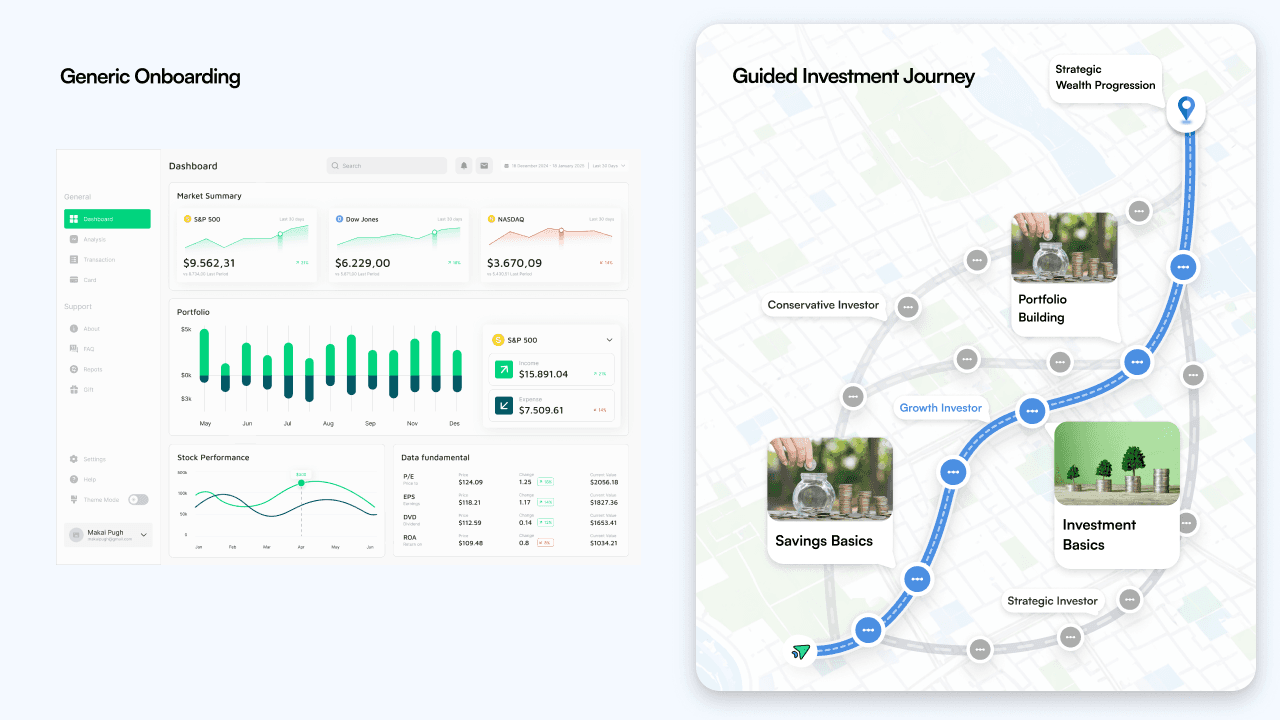
An online brokerage platform has millions of users and a rich education library covering everything from market basics to advanced derivatives. But every new user who opens an account sees the same homepage, the same content library, the same onboarding flow. A 22-year-old first-time investor with ₹10,000 to put away monthly sees the same experience as a 45-year-old trader managing a multi-crore portfolio. The platform acquires users at scale through low-fee positioning—but most new users never make it past their first few sessions. They browse education content, get overwhelmed by choice, and quietly disengage.
What MAP changes
MAP models each user across financial knowledge, money mindsets (anxiety, risk tolerance, decision confidence), income patterns, and financial goals. For the first-time investor, MAP senses through conversation that she understands savings but freezes at the word “equity.” Her financial anxiety is high. Her goal is modest: build a retirement habit. MAP doesn’t show her the full content library. It generates a personalized pathway that starts with low-stakes, confidence-building steps—a guided first SIP into an index fund, then a short module on how compound returns work, then a nudge when her first returns post. Each step is sequenced to reduce anxiety and build the investing identity before introducing complexity. For the experienced trader, MAP recognizes deep knowledge and high confidence, and routes directly to advanced tools and derivative strategies.
CAC
LTV
Health & Wellbeing
The Scenario
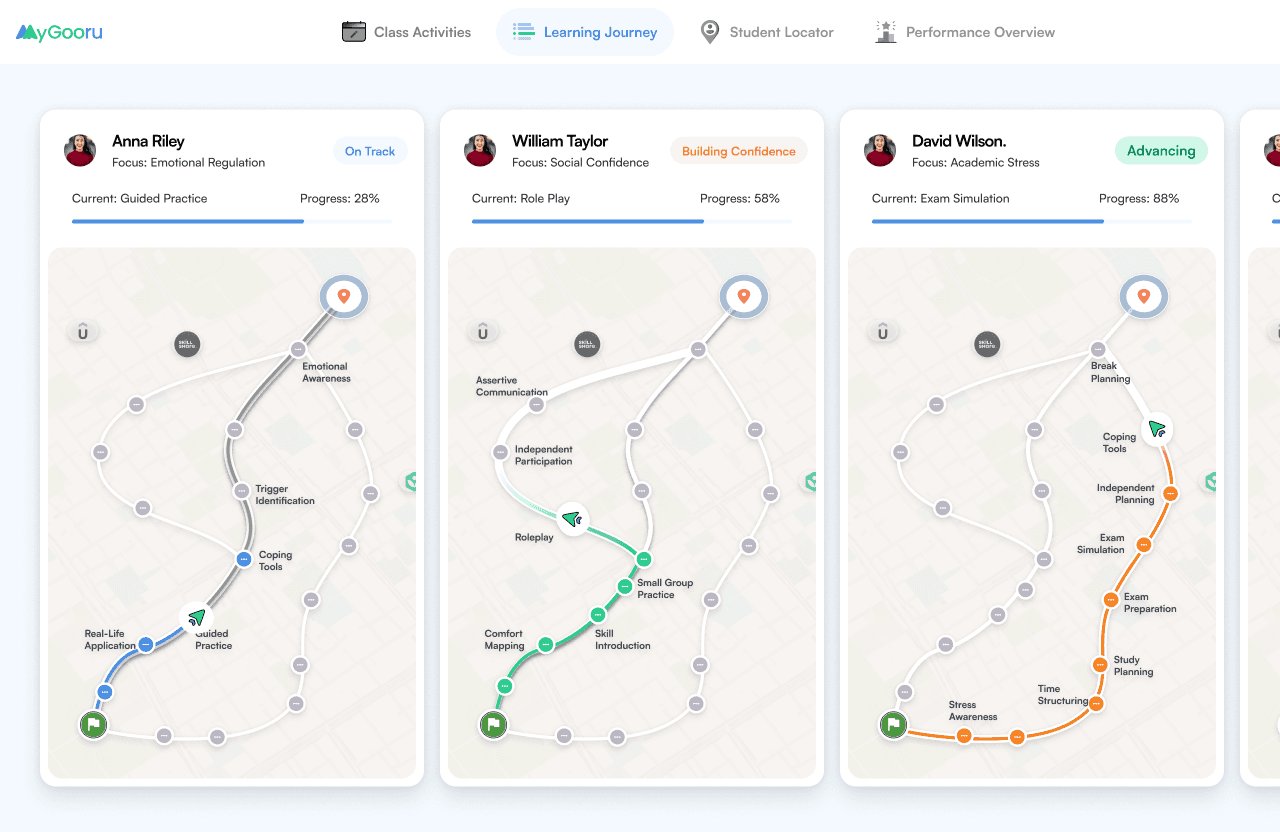
A youth mental health and emotional wellness platform sells to school districts. Their product features high-quality video content, interactive lessons on resilience, self-awareness, and emotional intelligence, and journaling tools. Schools are buying—the demand for student mental health support is acute. But the engagement problem is severe: after an initial wave of enthusiasm, student participation drops. A 6th-grader dealing with social anxiety watches the same resilience video as a confident 8th-grader who’s navigating family stress. Neither experience feels personal. Counselors have caseloads of 400+ students and can’t possibly individualize. The platform churns districts because administrators see declining usage and can’t justify renewal.
What MAP changes
MAP builds beliefs about each student across emotional knowledge, mindset dispositions, personal interests, coping abilities, and support systems. For the socially anxious 6th-grader, MAP senses avoidance patterns and low self-efficacy through journaling responses and interaction data. It generates a pathway that starts with safe, private reflection exercises, builds toward guided social scenarios, and coordinates with the student’s teacher to create low-pressure classroom participation moments. For the 8th-grader navigating family stress, MAP recognizes strong social skills but declining academic engagement, and routes toward stress management and help-seeking strategies—with a nudge to the school counselor when warning signs emerge. Every student’s journey is different because every student’s emotional landscape is different.
CAC
LTV
Enterprise Productivity
The Scenario
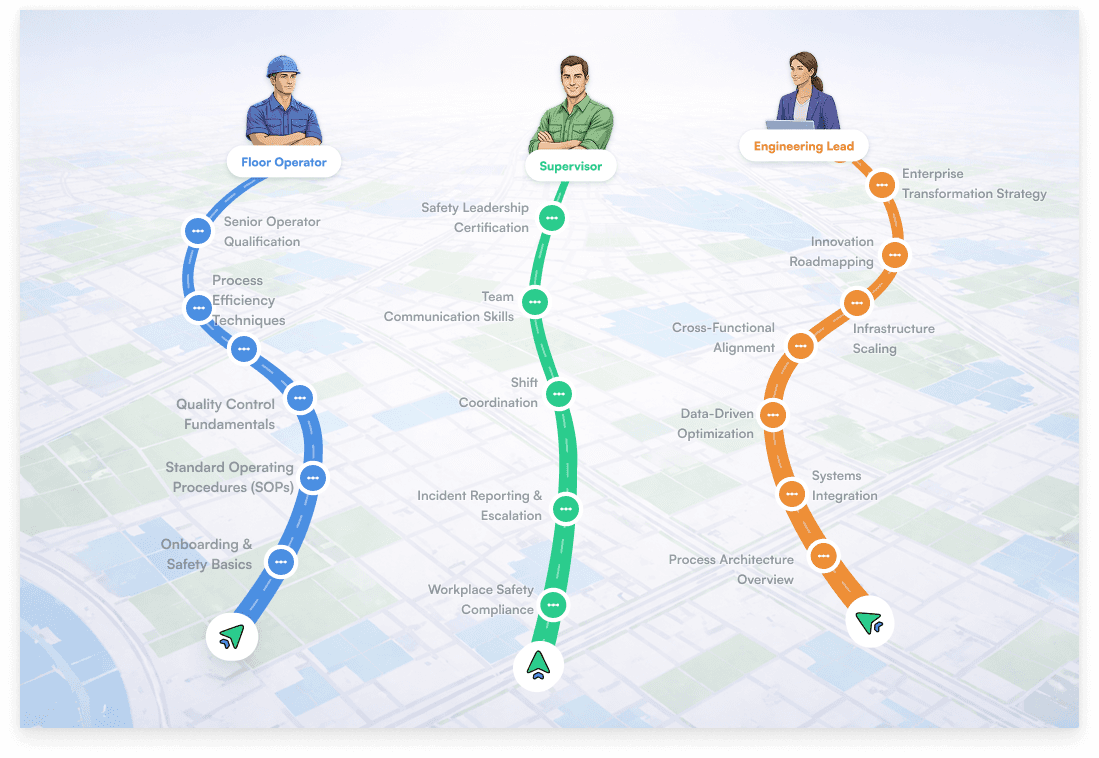
A large enterprise is rolling out AI-powered productivity tools across tens of thousands of employees—factory workers, middle managers, knowledge workers, executives. They invest heavily in training content: video modules, compliance courses, skill certifications. But the training is forgotten within days. A floor operator in a semiconductor plant watches the same AI-readiness module as a software architect in the R&D center. The operator needs hands-on process optimization skills she can apply on her shift tomorrow. The architect needs deep technical upskilling that builds on his existing expertise. Both disengage because the training feels disconnected from their actual work. The enterprise keeps spending on content production and LMS licenses but can’t demonstrate productivity impact—and can’t reduce the attrition that generic training was supposed to help prevent.
What MAP changes
MAP models each employee across job-specific competencies, learning confidence, career interests, current skill levels, and team dynamics. For the floor operator, MAP senses through on-the-job assessments that she has strong manual process knowledge but low confidence with digital tools. It generates a pathway that starts with quick, practical micro-lessons tied to her specific production line, builds digital confidence through guided practice on actual equipment interfaces, and coordinates with her supervisor to reinforce new skills during shift. For the software architect, MAP recognizes deep technical fluency and high autonomy, and generates an advanced pathway of hands-on AI implementation projects with peer collaboration. The enterprise sees which teams are building real capability—not just completing courses—and can measure the productivity improvement directly.