The Technology Behind GPS for Outcomes
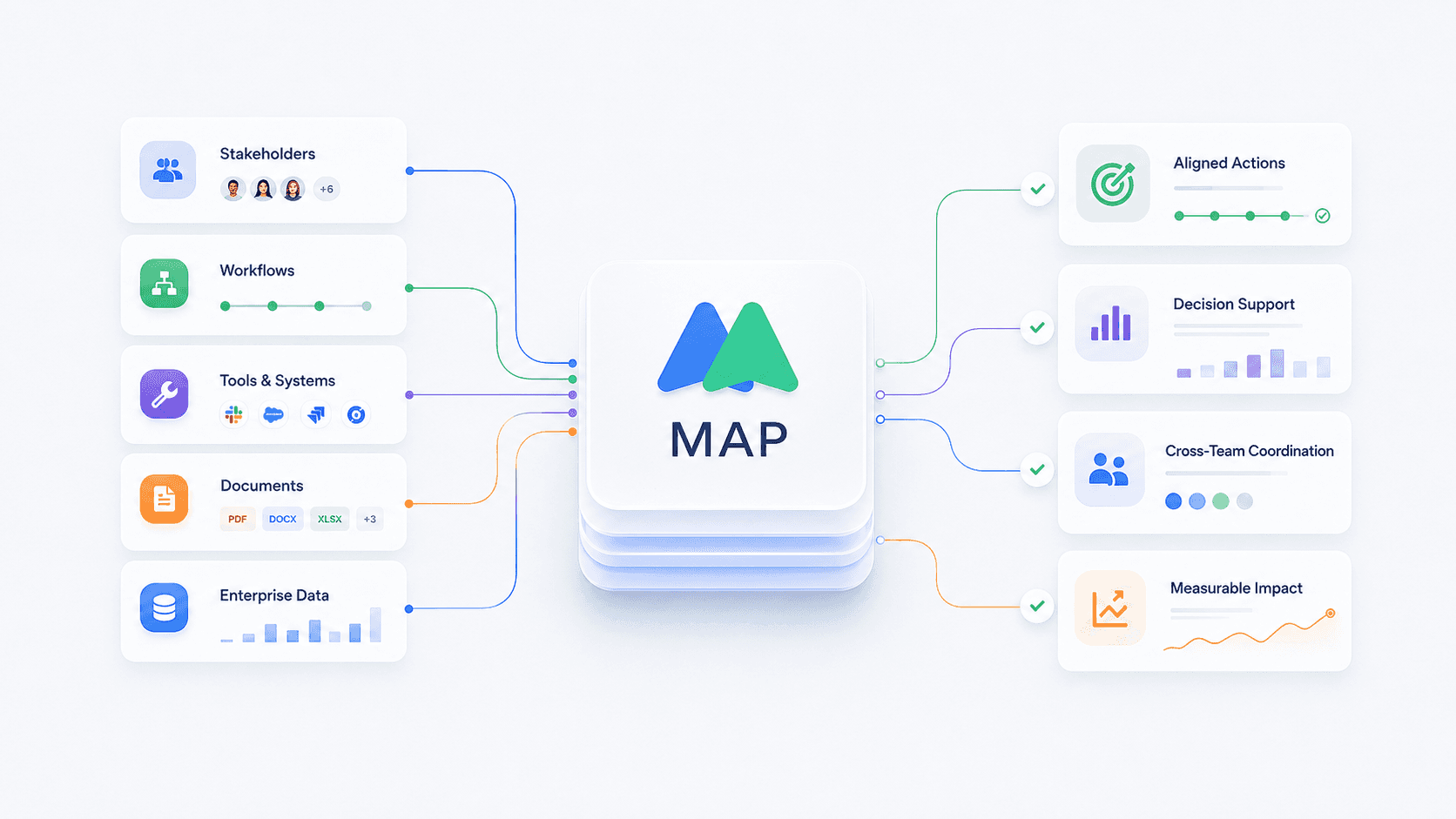
Formal reasoning on top of LLMs — making every domain computable so every individual gets a mathematically validated pathway to their outcome.

Making Every Domain Computable
Three steps from raw content to a closed algebraic space — where every computation is mathematically guaranteed to produce a valid result.
Digitize the Domain
Every domain has structure — prerequisites, dependencies, constraints, relationships. MyGooru converts that structure into mathematical representations called polylines: precise positions in domain space, the way GPS coordinates give every point on Earth a precise position in geographic space.
A curriculum is not a flat list of topics - it is a hierarchy of competencies with prerequisite dependencies and cross-domain connections. Clinical protocols are not checklists - they are sequenced treatments with contraindication rules and evidence thresholds. Financial products are not categories - they are a network of instruments with risk-return relationships and suitability constraints.
LLMs process unstructured content and extract structured relationships. Formal reasoning constrains those outputs into valid polyline structures, so every mathematical operation that follows is well-defined.
02
Formalize Domain Principles
Every domain has published science governing how it works - not invented by the system, but accumulated over decades of research.
In learning: neuroscience, cognitive science, psychology, and learning science establish that prerequisites must be mastered before advancement, that spaced retrieval strengthens retention, that productive struggle builds persistence, and that mindset and community affect the pace of knowledge acquisition.
In health: clinical protocols establish treatment sequencing, contraindication rules, and evidence thresholds. In financial planning: behavioral economics, risk theory, and life-stage research govern how individuals are guided toward financial goals.
The formal reasoning layer structures this published science into computational models that can enforce prerequisite chains, update beliefs from new evidence, evaluate alternative sequences, and transfer validated patterns across similar cases - turning decades of domain research into precise, actionable logic.
03
Algebraic Operators
Formalized domain principles decompose into compositions of five primitive algebraic operators: union (combine evidence), intersection (check constraints), complement (identify gaps), scalar product (weight and adjust), and projection (extract relevant dimensions).
These five operators form a complete algebra — closure, associativity, commutativity, distributivity. Every domain principle expressible through the reasoning models decomposes into compositions of these operators. Every composition produces a valid result within the closed space.
Because the algebra is complete and the space is closed, every domain principle can be executed on every individual and every computation produces a valid result. Mathematical rigor replaces human verification - even when the underlying beliefs carry non-zero uncertainty.
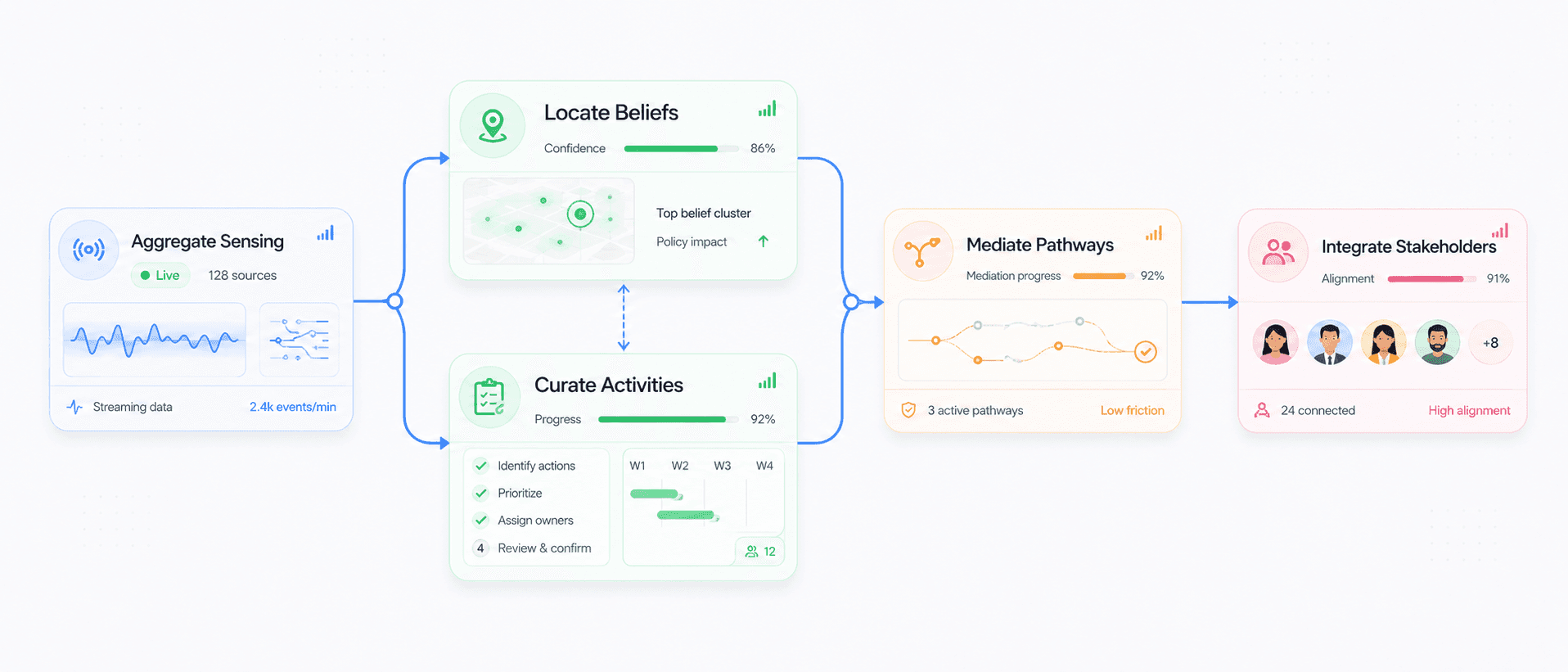
Active sensing. Calibrated beliefs. A continuously updated model of who each person is — not a static profile, but a living digital twin.
MyGooru develops calibrated beliefs - probabilistic models with quantified uncertainty - that update continuously as the individual interacts, progresses, and changes.
Active sensing drives this. MyGooru accesses all obtainable data about the individual: assessments, conversations, behavioral signals, self-declarations, time-on-task, response patterns, and interactions with content. From observable behavior, formal reasoning infers the latent states that govern what the person is actually ready for - not just what they scored, but what they know, how they engage, what motivates them, and what support they have.
Every observable signal updates beliefs. Every belief update refines the pathway. The loop runs continuously.
Beliefs span five facets — a model of the whole person:
Knowledge — what they have mastered and where specific gaps exist, mapped against the computable domain.
Mindsets — growth orientation, persistence, self-efficacy, and other psychological attributes that affect engagement with difficulty.
Interests — engagement patterns across content types, contexts, and modalities.
Abilities — working memory, attention span, learning pace, and cognitive load tolerance.
Community — support systems, peer relationships, family involvement, and cultural context.
Together these five facets constitute a continuously updated digital twin. That individual precision is what makes N=1 pathways possible.
From Beliefs to Pathways
Domain science simulates every possible route. The system selects the most effective and efficient one for this individual at this moment.
Once the system knows where an individual is - their belief state across all five facets - it uses domain principles to compute every valid pathway forward.
For learning, this means applying neuroscience, cognitive science, psychology, and learning science across all possible routes simultaneously: prerequisite chains are enforced (symbolic reasoning), new evidence updates estimates of mastery (probabilistic reasoning), alternative sequences are evaluated before committing (counterfactual reasoning), and causal reasoning traces how closing one gap enables the steps that follow.
From the set of valid pathways, the system selects the one that is both valid - grounded in domain science, respecting every prerequisite and constraint - and optimal - the most effective and efficient route for this individual at this moment, given their belief state, learning pace, and engagement patterns.
Every step is auditable. The system can explain which domain principle governs each transition. Every activity in the pathway has a scientific rationale
The same formal reasoning infrastructure powers different applications for different contexts — the way the same GPS infrastructure powers Waze, Google Maps, and fleet management systems.
Formal reasoning (Layers 2 and 3) is domain-agnostic infrastructure. What sits on top of it - Layer 4 - are conversation-based applications configured for specific problem contexts and stakeholder roles.
Every stakeholder application is primarily a conversation with AI: the individual navigates their pathway, the coach sees their cohort's belief states and receives intervention recommendations, the program leader sees whether institutional goals are on track. AI provides the navigation. Human judgment shapes every intervention. The two work in concert - which is why every activity in the pathway has a scientific rationale the stakeholder can see and act on.
Applications are configurable for any domain where the infrastructure has been deployed. The architecture does not change. What changes is what gets digitized, what science governs the reasoning, and who the stakeholders are. A learning deployment and a health deployment run the same formal reasoning loop on different computable domains.
15 Years of Research.
$35 Million in R&D.
Three Patents.
5.3 Million Users.
This architecture is the product of 15 years of research and $35 million in funded R&D - across the National Science Foundation, the US Department of Defense, the Gates Foundation, and Google.org. Three provisional patents protect it. Validated across 5.3 million users.
Formal reasoning on LLMs is not an enhancement to existing AI approaches. It is a fundamentally different kind of computation - domain computability that produces what LLMs alone cannot: mathematically validated pathways for every individual, grounded in the domain's own published science, updated continuously from active sensing.
Proven first in learning. Architected for every domain where individuals have goals and institutions are accountable for outcomes.